Blooms Taxonomy and Millers Competency.
Blooms
1.Knowledge: remembering of previously learned material; recall (facts or whole theories); bringing to mind.◦Terms: defines, describes, identifies, lists, matches, names.
2.Comprehension: grasping the meaning of material; interpreting (explaining or summarizing); predicting outcome and effects (estimating future trends).◦Terms: convert, defend, distinguish, estimate, explain, generalize, rewrite.
3.Application: ability to use learned material in a new situation; apply rules, laws, methods, theories. ◦Terms: changes, computes, demonstrates, operates, shows, uses, solves.
4.Analysis: breaking down into parts; understanding organization, clarifying, concluding.◦Identify parts; See Related Order; Relationships; Clarify.◦Terms: distinguish, diagrams, outlines, relates, breaks down, discriminates, subdivides.
5.Synthesis: ability to put parts together to form a new whole; unique communication; set of abstract relations.◦Terms: combines, complies, composes, creates, designs, rearranges.
6.Evaluation: ability to judge value for purpose; base on criteria; support judgment with reason. (No guessing).◦Terms: appraises, criticizes, compares, supports, concludes, discriminates, contrasts, summarizes, explains.
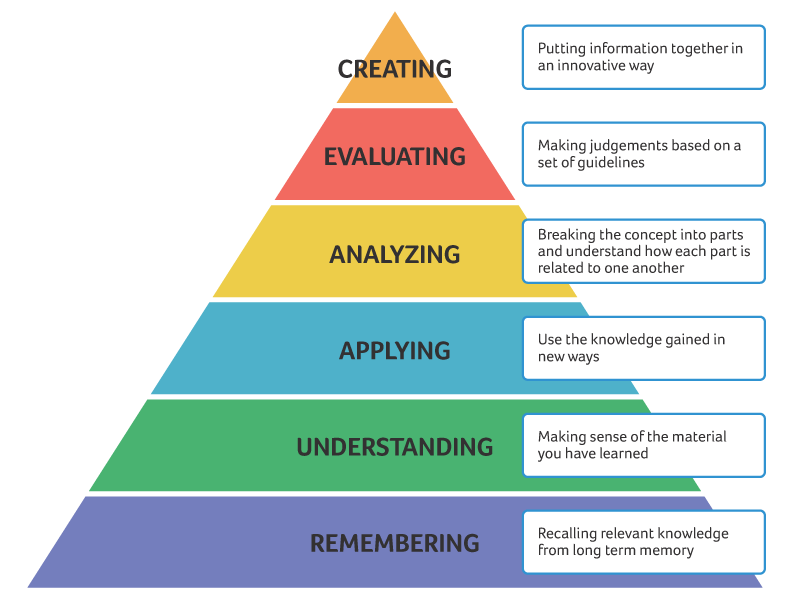
Bloom's Taxonomy was published in 1956 by educational expert Dr Benjamin Bloom. Bloom's Taxonomy was originally created in and for an academic context whose aim was to develop a system of categories of learning behaviour to assist in the design and assessment of educational learning.
Bloom's Taxonomy was primarily created for academic education, however it is relevant to all types of learning. Bloom believed that education should focus on 'mastery' of subjects and the promotion of higher forms of thinking, rather than a utilitarian approach to simply transferring facts.
Bloom demonstrated decades ago that most teaching tended to be focused on fact-transfer and information recall - the lowest level of training - rather than true meaningful personal development, and this remains a central challenge for educators and trainers in modern times. This is reason alone to consider the breadth and depth approach exemplified in Bloom's model.
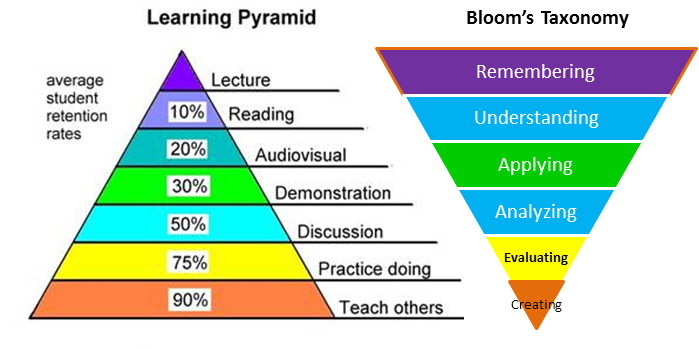
Learning pyramid.
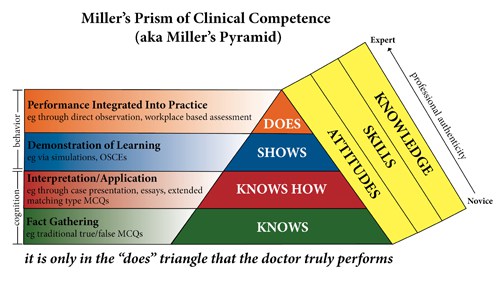
Millers Pyramid of clinical competency,